

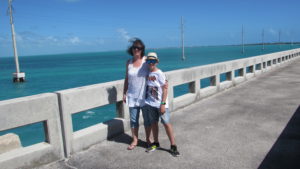
 Heute habe wir unsere Zelte in Miami abgebrochen und machen uns auf Richtung Süden zu den Florida Keys.
Zuerst mal durch den dichten Stadtverkehr von Miami, kommen wir schon bald auf den Highway 1, der schnurstracks den Weg Richtung Süden zeigt. Leider ist diese Strasse nur einspurig, so geht vor Key Largo erst mal nichts mehr. Ca. 1 Stunde geht es nur Schritttempo und Stop and go weiter.
Später verflüssigt sich der Verkehr wieder und die Landschaft wir spektakulär. Insel um Insel reiht sich im türkisfarbenen Meer aneinander, verbunden durch lange Brücken. Wirklich sehr eindrücklich und wunderschön.
Da uns die Hotels in Key West einfach zu teuer waren, haben wir für 2 Nächte im „Courtyard by Marriott“ in Marathon gebucht. Der Ort, eine typische hässliche amerikanische Kleinstadt, liegt ca. 50km vor Key West und bietet nicht viel. Das Hotel ist jedoch der Hammer. Wir bekommen ein tolles, grosses Zimmer mit Meerblick, der palmenbesäumte Pool scheint geradewegs ins Meer überzugehen, fantastisch!
Um 15.00 buchen wir gleich nebenan eine interessante Tour im „Turtle Hospital“, einer Auffangstation für kranke und verletzte Meeresschildkröten.
Nach einer Abkühlung im Pool bringt und der hoteleigene Shuttle-Bus zu einem schönen Restaurant, wo wir zum ersten Mal richtig gut essen.
Morgen geht es dann nach Key West.
I’ve spent more evenings than I’d like to admit chasing that perfect merge, and the satisfaction of finally hitting a 2048 tile never gets old. What’s great is that the core logic is simple, but the strategy deepens quickly once you start planning ahead. If you’re looking to sharpen your approach or just want a fresh board to test new tactics, the version that keeps me coming back is available right here: 2048. It’s a clean, distraction-free take on the classic, which makes it easy to focus on building those corner chains. Whether you’re a beginner or a seasoned swiper, that extra step of foresight changes everything.
Temperature conversions pop up more often than you’d think—whether you’re adjusting an oven recipe from Celsius, checking a weather forecast in Fahrenheit, or working on a science project. The tricky part is remembering the exact formulas, especially when you’re in a hurry or dealing with negative values. Instead of doing mental math, I’ve found it helps to keep a reliable conversion tool handy. For anyone who wants to double-check their results or handle less common scales like Kelvin, the temperature section on our Temperature breaks it down clearly and quickly. It’s a straightforward way to save time and avoid errors, no matter which unit you’re starting from.
It’s always satisfying when a game balances challenge with fair mechanics, and that’s exactly what I’ve been digging into lately. The depth here isn’t just about graphics or hype—it’s the small design choices that keep you coming back for another round. I’ve spent more evenings than I care to admit testing different strategies, and the variety of modes really helps shake off the monotony that plagues so many titles in this space. For anyone who enjoys dissecting gameplay systems or just wants a fresh way to unwind, this is a solid pick. To explore the topic further, readers can use our gamedayer.com for a quick overview of what’s currently trending in the community. Either way, it’s refreshing to see a developer take risks without losing sight of what makes games fun in the first place.
This piece really cuts through the noise about how we consume media today. It’s easy to forget how much our viewing habits have shifted, but the points here about accessibility and changing expectations are spot on. For anyone curious about the technical side of staying connected while streaming or working from home, our posterwifi offers a straightforward look at optimizing your setup. The examples given in the article translate well into practical advice, which is refreshing. I’ve already shared this with a few friends who are always hunting for better solutions, and it sparked a good discussion about what the next few years might hold for entertainment and connectivity alike.
There’s something quietly powerful about pausing for a single card pull when your thoughts are tangled. Tarot doesn’t predict so much as it mirrors—offering a fresh angle on choices you’ve been circling. I’ve found that even a simple three-card spread can untangle a stubborn dilemma, especially when you frame the question honestly. The trick is not to seek a verdict, but to notice which card sparks a reaction. That gut response is often the real insight. For anyone curious about structured self-reflection, the guides at Tarot Bitio break down each card’s nuance without turning it into a rigid formula. If you’re new to this, a daily one-card draw is a low-pressure way to build the habit. To explore the topic further, readers can use our Tarot Bitio for a full library of spreads and meanings—handy when you want to go deeper than a quick yes or no.
This is a handy stop for anyone who works with text all day. Whether you need to quickly format a block of code or generate a random fact for a quiz, having these utilities in one place saves a lot of tab-switching. The animal section, for instance, offers a fun way to pull up quick facts or names for creative projects. If you're looking for more resources like this to streamline your daily tasks, our Animals covers a wider range of categories beyond just the basics. It’s worth a bookmark if you value efficiency without the clutter.